
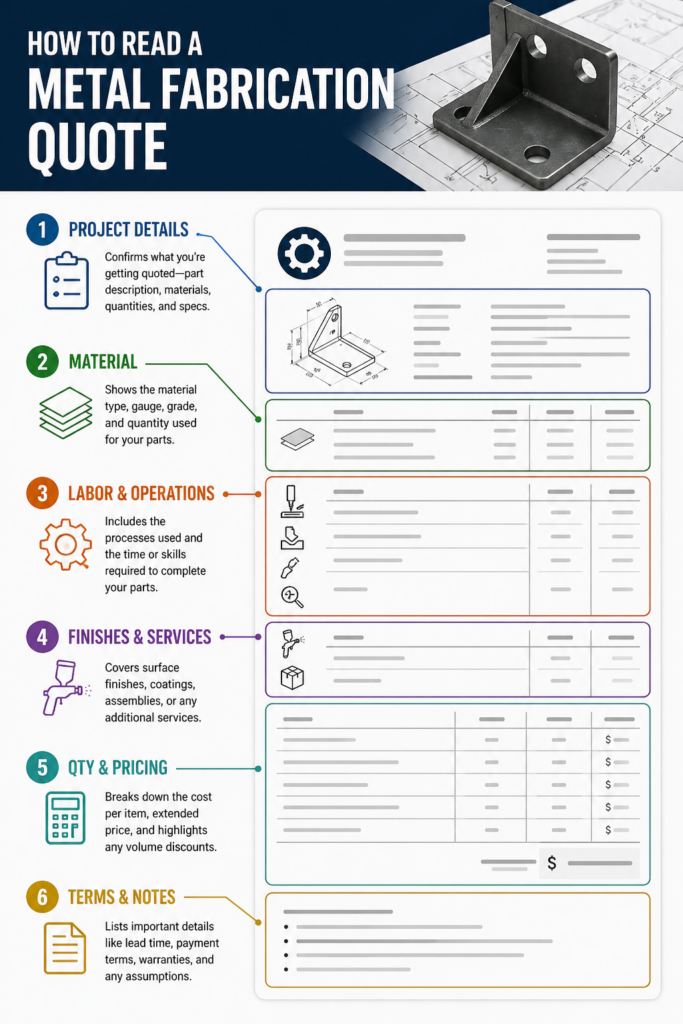
A metal fabrication quote lands in your inbox and the first thing you see is a unit price. But that number alone tells you almost nothing about what you’re actually buying — or what it will truly cost by the time parts reach your dock. Knowing how to read a metal fabrication quote is one of the most practical skills a procurement engineer or project manager can develop. It’s the difference between a confident sourcing decision and an expensive misunderstanding three weeks into production.
At AP Precision Metals, we’ve been quoting and manufacturing precision metal components for OEMs for over 20 years from our San Diego facility. We’ve seen the full range — quotes that communicate everything clearly and quotes that bury critical assumptions in vague line items. This guide walks through every major component of a fabrication quote, what each one means, and what to watch out for before you sign off.
A Metal Fabrication Quote Is More Than a Price — It’s a Scope Document
The most important shift in mindset when reading a fabrication quote is to stop treating it as a price sheet and start treating it as a scope document. Every line item is a statement about what the supplier will and won’t do — and the gaps between line items are often where cost surprises live.
A quote that says “$4.75 per part” is incomplete information. A quote that says “$4.75 per part, based on 500-piece quantity, 12-gauge 304 stainless steel, laser cut and deburred, powder coat excluded, 3-week lead time, FOB San Diego” is a scope. The second version gives you everything you need to evaluate the offer, compare it against competitors, and build an accurate landed cost for your bill of materials.
Before you evaluate any fabrication quote, confirm it contains answers to these five questions:
- What drawing revision and part number is this quote based on?
- What material — grade, alloy, gauge or thickness — is specified?
- What processes are included in the unit price, and which are quoted separately?
- What is the lead time and delivery basis (FOB origin vs. destination)?
- How long is this quote valid?
If any of these are missing, ask before you proceed. Ambiguity in a quote almost always resolves in favor of the supplier at invoice time.
The Line Items Every Fabrication Quote Should Include
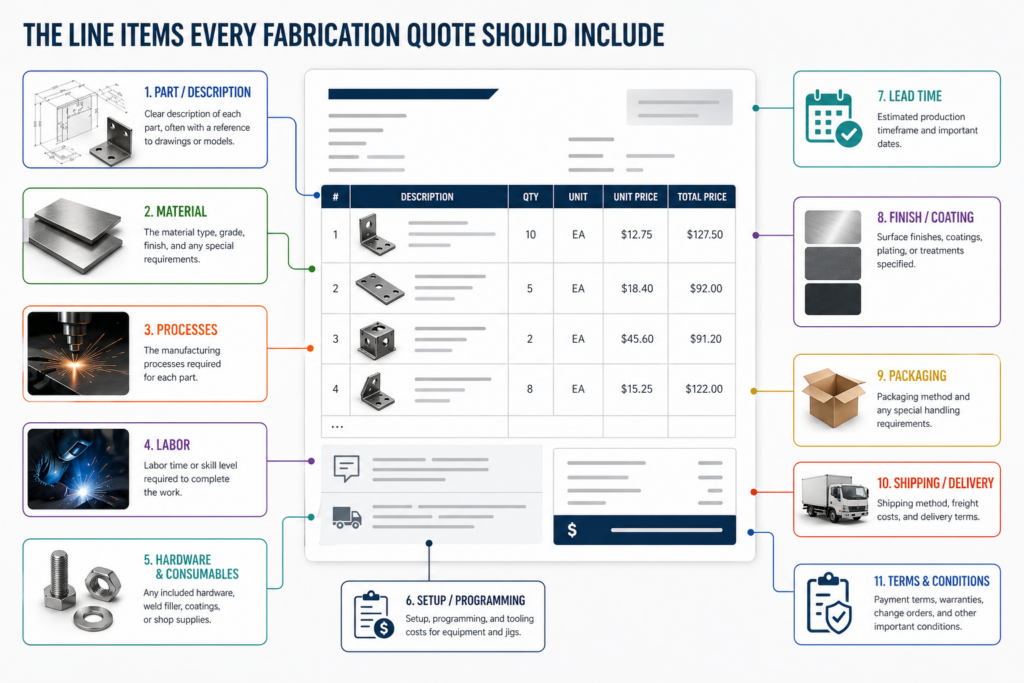
A well-structured metal fabrication quote breaks costs into distinct categories rather than rolling everything into a single unit price. Here’s what to expect and what each category covers:
Material Cost
This is the cost of the raw metal — sheet, plate, bar stock, tube, or structural profile — required to produce the part. Some suppliers quote material as a separate line item with the grade, thickness, and weight called out explicitly. Others fold it into the unit price. Either approach is acceptable, but you should be able to identify what material is being used and at what cost. Material pricing is tied to market rates for steel, aluminum, stainless, and other alloys, which fluctuate. A quote with an explicit material line item is easier to update when you requote at a different quantity or when commodity prices shift.
Setup and Tooling Fees
Setup fees cover the time and labor required to program CNC equipment, create laser cutting files, build fixtures, and prepare machinery before the first part is cut. This is a legitimate and expected cost in precision fabrication — it reflects real work that happens regardless of order quantity. Setup fees are typically charged once per order, not per part, which is why unit prices drop significantly at higher quantities.
Some suppliers omit a visible setup line and absorb it into the unit price. This can make their per-part price look higher than a competitor who charges setup separately — but the total cost may be identical. Always compare total order cost, not unit price in isolation.
Unit Price and Quantity Tiers
The unit price is the per-part cost at a specific order quantity. Most fabrication quotes include tiered pricing — the unit price decreases as quantity increases, because fixed costs like setup and programming are spread across more parts. A well-structured quote will show pricing at multiple quantity breaks, such as 100, 250, 500, and 1,000 pieces, so you can make informed decisions about order frequency and inventory.
Secondary Operations
Secondary operations are any processes performed after the primary forming step — cutting, punching, or bending. These are often quoted as separate line items and include:
- Welding: MIG, TIG, spot, or robotic weld, priced per assembly or per weld joint
- Hardware insertion: PEM nuts, standoffs, studs pressed into sheet metal parts
- Deburring and edge finishing: Removal of sharp edges from cut or punched parts
- Painting and powder coating: In-house or subcontracted finishing, priced per part or per batch
- Assembly and kitting: Sub-assembly labor, packaging, or labeling for parts shipped ready to install
At AP Precision Metals, our integrated capabilities — fabrication, cutting, welding, painting, and assembly — mean these secondary operations are performed in-house rather than subcontracted out. That eliminates the markup and lead time typically added when a supplier sends parts to a third party for finishing.
Inspection and Quality Documentation
For OEM and defense customers, first article inspection reports, material certifications, and certificates of conformance are often required deliverables. Some suppliers include these at no charge; others line-item them separately. If your program requires AS9100, ITAR compliance, or specific quality documentation, confirm what’s included in the quote and what costs extra. AP Precision Metals operates under an ISO 9001:2015-certified quality management system, and our quality documentation capabilities are part of the standard service offering.
Freight and Delivery Terms
Delivery terms define who bears the cost and risk of shipping. FOB Origin means the buyer takes ownership — and pays freight — once the shipment leaves the supplier’s dock. FOB Destination means the supplier covers freight to your facility. These terms materially affect landed cost and are often buried in the fine print. A quote that looks competitive on unit price but is FOB Origin versus a competitor quoting FOB Destination may be more expensive in total once freight is added.
What Does “Setup Fee” Mean — and Is It Negotiable?
Setup fees are one of the most frequently misunderstood line items in a fabrication quote. They’re not arbitrary charges — they represent real engineering and labor costs: writing CNC programs, setting up laser cutting files, building fixtures, and doing trial runs to verify the first part is within tolerance before the production run begins.
Setup fees are most worth scrutinizing in two situations:
- On repeat orders: If you’ve ordered the same part before and the supplier already has the program and fixtures, a full setup charge on a repeat order may be negotiable. Many suppliers charge a reduced re-setup fee for existing programs.
- On very high quantities: At large production volumes, setup costs become negligible per part. If a supplier is quoting high quantities with a large setup fee still visible, ask whether it can be amortized differently.
Lead Time and Delivery Terms Are as Important as the Price
A quote with an attractive unit price and a 10-week lead time may cost you more in expediting, safety stock, and production delays than a slightly higher-priced supplier who can deliver in three weeks. Lead time is a cost — it just doesn’t appear on the quote as a dollar figure.
When evaluating lead time in a fabrication quote, ask:
- Is this lead time from receipt of order or from receipt of approved drawing?
- Does it include time for first article approval, or does the clock start after FAI sign-off?
- What happens to lead time if you increase the quantity?
- Is expedited production available, and at what premium?
AP Precision Metals maintains ample machine redundancy across our San Diego facility specifically to protect lead time commitments — if one cell is at capacity, production can shift without pushing customer deliveries.
Red Flags to Watch for in a Metal Fabrication Quote
Not every quote is as complete as it appears. These are the warning signs that a quote may be missing scope, hiding costs, or setting up a difficult conversation at invoice time:
- No drawing revision referenced: If the quote doesn’t specify which revision of your drawing it’s based on, any change — even a minor one — becomes grounds for a requote or change order.
- Vague material callout: “Steel” is not a material specification. “12-gauge cold-rolled 1018 steel” is. Vague material callouts leave room for substitution with a cheaper, lower-quality alternative.
- Unit price only, no total cost breakdown: A single-line quote with one price and nothing else is a red flag. You have no visibility into what’s included and what isn’t.
- No lead time stated: “Standard lead time applies” without a number is not a commitment. Get a specific date or week range in writing.
- Quote validity shorter than your procurement cycle: A 15-day quote validity on a part with a 30-day approval process puts you in a difficult position. Ask for extended validity if your timeline requires it.
- No mention of finishing or secondary ops: If your part requires powder coat, hardware, or assembly and the quote doesn’t mention them, they’re almost certainly not included — and they’ll show up as add-ons later.
Frequently Asked Questions About Reading Fabrication Quotes
What should a metal fabrication quote include?
A complete metal fabrication quote should include material specification and grade, unit price and quantity pricing tiers, setup or tooling fees, secondary operations such as welding or finishing, lead time, payment terms, and the drawing revision the quote is based on. Missing any of these creates ambiguity that typically resolves as cost surprises at invoice time.
Why do fabrication quotes vary so much between suppliers?
Quote variation comes from differences in how each supplier interprets your drawing, their material sourcing costs, overhead structure, process capability, and what they choose to include or exclude. A significantly lower quote often means something is excluded — setup fees, a finishing step, or inspection — rather than the supplier being genuinely more efficient than competitors.
What is a setup fee in a fabrication quote?
A setup fee covers the labor and time required to program, fixture, and prepare machinery before production begins. It is typically a one-time charge per order rather than per part. Setup fees are normal and expected in precision fabrication — a quote with no visible setup fee may simply have that cost rolled into the unit price instead.
How do I compare quotes from multiple fabrication suppliers?
Confirm that all quotes are based on the same drawing revision, material specification, and quantity. Then add all line items — unit price, setup, secondary operations, and freight — to calculate a true total cost per part. Comparing only unit prices without accounting for setup fees, finishing, and delivery terms produces a misleading comparison that often reverses once the full picture is visible.
What does “quote validity” mean on a fabrication quote?
Quote validity is the window during which the quoted price is guaranteed. Most fabrication quotes are valid for 30 to 60 days, after which material cost fluctuations or capacity changes may require the supplier to requote. If your procurement timeline extends beyond the validity window, ask your supplier about price lock options before the quote expires.
Read the Quote Like a Contract — Because It Is One
A metal fabrication quote is the foundation of every production relationship. The more clearly it defines scope, material, process, and terms, the fewer surprises you’ll encounter from first article through full production. Learning to read it critically — line by line, with an eye for what’s missing as much as what’s there — is one of the best investments an OEM engineer or procurement professional can make.
At AP Precision Metals, our quotes are built to be transparent. We call out material grades, process steps, setup, lead time, and quality requirements explicitly — because we’d rather align on scope before production than resolve disputes afterward. If you’re ready to get a quote on your next metal fabrication project, contact our team at (619) 628-0003, email [email protected], or request a quote online today.